
'The Indian economy is at a crossroads,' says Professor Jagdish Bhagwati, a University Professor at Columbia University and senior adviser to the Institute.
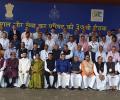
This is a moment when the leaders at the Centre and states must show true leadership for the sake of the country. And it is the top political leaders, not attorney generals or bureaucrats, who should be sitting together and settling this thorny issue of compensation, says Arvind Subramanian, former Chief Economic Adviser to the Government of India.
Martin Feldstein, George F Baker Professor of Economics at Harvard University, speaks about the global economic situation.

Gandhi said he was proud that his father Rajiv Gandhi and grandmother Indira Gandhi got killed while standing and defending something.

It will be interesting to see whether India-China border tensions figure during the deliberations of PLA deputies to the NPC and CPPCC, notes Jayadeva Ranade, the distinguished China expert and retired RA&W officer.

'The rise in unemployment, underemployment, discouraged workers and job insecurity is likely to continue, with very adverse consequences for the nation's economic well-being and social cohesion,' warns Shankar Acharya.

'A firm national resolve can only deter and defeat the nefarious designs of the adversary,' notes Rup Narayan Das.

'We behaved as if this disease is not a problem for India.' 'We acted as if it would go away. But it didn't go away; it exploded.'

The government's predicament is a result of its own doing: That of not ensuring adequate buy-in by the stakeholders before passage of the laws, notes Vivek Gumaste.

Financial globalisation - or ultra globalisation - has done more harm than good to the majority of economies, say Anshuman Gupta & Karunakar Jha.

Hasty, ill-conceived steps show how isolated Mamata Banerjee had been from the national political trend. A fascinating excerpt from Sugato Hazra's Losing The Plot: Political Isolation Of West Bengal.

Thomas Isaac has been in and out of the national news in his role as Kerala's finance minister since 2018 for various path-breaking tax initiatives. But it is 2020 that he has become more prominent, principally in the GST council.

'Opening everything is not appropriate ... everyone has been saying the third wave is a couple of days away'

You may be popular initially because of politics and ideology but if the economy slows down, you will be losing your popularity: Nouriel Roubini.

If even a fraction of the 175 GW target is achieved, India's reliance on coal and oil would be reduced, says expert.
Many are selling stocks and corporate bonds and putting their money into gold.
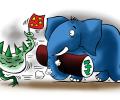
Nomura Group Study found that in 2019, out of the fifty-six companies which shifted their production out of China, only three of these invested in India; while 26 went to Vietnam, 11 to Taiwan, and 08 to Thailand. In April 2020, Nikkei noted that out of the 1,000 firms which were planning to leave China and invest in Asian countries, only 300 of them were seriously thinking of investing in India.

'The theme of death seems to be a theme about which many of us, raised in Western societies, have almost completely removed from consciousness; it represents a theme that is suddenly and forcefully resurging now.' 'And for some, this is scary and destabilising.'
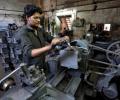
The fall in investment rate is not surprising. But putting it together with rising share of wages in GVA, it shows that the focus is more on productivity, rather than adding new capacity, says Pronab Sen, former chief statistician of India.

India needs to make use of this opportunity to significantly enhance its exports especially in information and communications technology and the automotive sector.

A traumatic medical emergency drove physician Dr Devi, of General Hospital soap fame, to run for public office in New York.

'It's official: we won. I'm going to Albany to fight to tax the rich, heal the sick, house the poor & build a socialist New York. But I can't do it alone. To win socialism, we'll need a mass movement of the multiracial working class as well. So let's build one,' Mamdani tweeted.
What happens if China depreciates its currency. In that case, Chinese products will be cheaper and people will continue to buy their products: Abhijit Banerjee.

Hectic preparations are on at the newly-formed Niti Aayog to welcome the first Vice-Chairman Arvind Panagariya and other members whose appointments were approved by Prime Minister Narendra Modi on Monday.
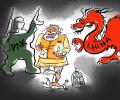
'China need not worry about a truly 'resurgent India'.' 'It's not going to happen.'

'Wild animals lived in their natural environment.' 'So, viruses could not be communicated.' 'Then came mass production and mass quartering of animals -- whether it be poultry, pigs and cattle -- which gave rise to bird flu, SARS and the mad cow disease.' 'Vast amounts of animal produce are also being flown from one part of the world to another, which has helped to spread the virus.' 'All these changes have led to a new and deadly mutation of the virus that has immobliised human beings.'

A report published in British journal The Lancet reckons India's working population will surpass China's in the mid-2020s.
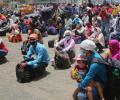
The study noted that nine of 30 large states -- Madhya Pradesh, Bihar and Telangana, Jharkhand, Uttar Pradesh, Maharashtra, West Bengal, Odisha, and Gujarat -- have high vulnerability to be impacted by the COVID-19 pandemic.
What will it take the next government to revive growth? Arvind Panagariya, Jagdish Bhagwati Professor of Indian Political Economy at Columbia University, and one of the world's leading economists, offers a checklist.

Prime Minister Modi made a strategic blunder of Nehruvian proportions -- presuming no war can happen now, and the Chinese won't be a military threat and risk their economic interests, observes Shekhar Gupta.

Economist who predicted global crash says India needs to both spend and tighten and it won't be easy.

He received the DSc (Econ) for distinction in economics.
.jpg)
Indian-American economist Arvind Panagariya has said that he is "honoured" to be appointed by Prime Minister Narendra Modi as the first Vice Chairman of the newly created NITI Aayog, which replaces the 65-year-old Planning Commission.

Although the first woman to hold the position of chief economist at IMF, it would be wrong to see her appointment through the lens of gender
T N Srinivasan, Samuel C. Park, Jr. Professor of Economics, Yale University, giving his opinion on the Indian Union Budget 2009 at Asia Society in New York.

'India-China economic ties are likely to take a hit in the wake of the new situation, but that also provides India with a new opportunity to strengthen its manufacturing base,' points out Dr Rajaram Panda.
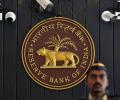
The Reserve Bank of India (RBI) is precariously balancing two opposing objectives - maintaining easy financial condition in the domestic market, while ensuring external stability - and economists have started taking note. They say India is going through the classic trilemma of the 'Impossible Trinity'. The RBI cannot have an independent monetary policy (setting domestic interest rates) in an environment of an open capital account and flexible exchange rates. What is even more complicated for the central bank now is that financial market stability overlays all the other three objectives.

'The solution is to enable a graceful transfer of the deposit and funding 'franchise' from capital-deficient firms to capital-surplus firms.' 'This will expand credit intermediation, bring down its costs, and put the financial sector on a definite path of recovery,' argues former RBI deputy governor Viral Acharya.
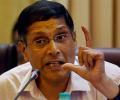
'In the short-term, the markets may be affected' by the review but 'it will help address what they are worried about which is why we need transparency,' says former chief economic advisor.
Recent growth has wrought enormous environmental destruction and degradation in India, says Praful Bidwai.
 © 2026 Rediff.com - Advertise with us - Disclaimer - Privacy Policy - Sitemap - Feedback - About us - Terms of use - Grievances